 Spicy Trip

Introduction to Legal Considerations for Sex-Positive Events
Hosting sex-positive parties and kink events in 2026 demands thorough understanding of consent laws, privacy protections, and liability risks. Aspiring organizers must balance creating inclusive spaces with strict adherence to local and international regulations. This comprehensive guide examines core legal frameworks, distinctions between event types, insurance needs, and regional variations. It offers detailed compliance checklists, real-world mitigation examples, and answers to frequent questions, empowering hosts to operate safely and lawfully while fostering positive experiences for all attendees.
Understanding Consent and Privacy Frameworks
Consent remains the foundational element of any sex-positive gathering. Modern legal standards in 2026 stress that consent must be affirmative, enthusiastic, ongoing, and freely revocable at any moment. Organizers are advised to implement written consent protocols that clearly outline boundaries and communication methods. Privacy considerations involve secure collection and storage of personal data, including identification for age verification. Failure to protect attendee information can lead to violations of data protection statutes, resulting in fines or civil claims. Hosts should also address digital privacy by using encrypted platforms for RSVPs and communications.
Private vs. Public Gatherings: Key Distinctions
The legal treatment of events hinges on whether they qualify as private or public. Private gatherings, typically hosted in residences or exclusive rented spaces with pre-vetted guests, generally encounter fewer regulatory hurdles. These events may still require basic liability measures but avoid many zoning or licensing mandates. In contrast, public events open to ticketed attendees or advertised widely often trigger additional oversight, including health department inspections, occupancy limits, and adherence to public decency ordinances. Understanding these classifications helps organizers select venues and formats that minimize exposure while maximizing attendee safety and enjoyment.
Insurance Requirements and Liability Management
Specialized event liability insurance is critical for protecting against claims arising from injuries, property damage, or allegations of misconduct. Policies should explicitly cover adult-oriented activities and include provisions for legal defense costs. In addition to general liability, hosts may consider adding coverage for liquor liability if alcohol is served and directors and officers insurance for larger organizing teams. Real-world applications demonstrate that pairing robust insurance with signed waivers and clear house rules significantly lowers the likelihood of successful lawsuits. Regular policy reviews ensure alignment with evolving 2026 standards.
Local Regulations Across Major Regions
Regulatory landscapes differ substantially by location. Within the United States, state obscenity statutes and assembly laws govern many aspects, with federal guidance available through the U.S. Department of Justice. European Union members must comply with strict data protection rules under GDPR and local public order regulations. The United Kingdom emphasizes licensing for larger events via the UK Home Office, while Canada and Australia impose additional provincial or state-level requirements around consent education and venue safety. Hosts planning multi-city tours should map these differences early to avoid compliance gaps.
Step-by-Step Compliance Checklist
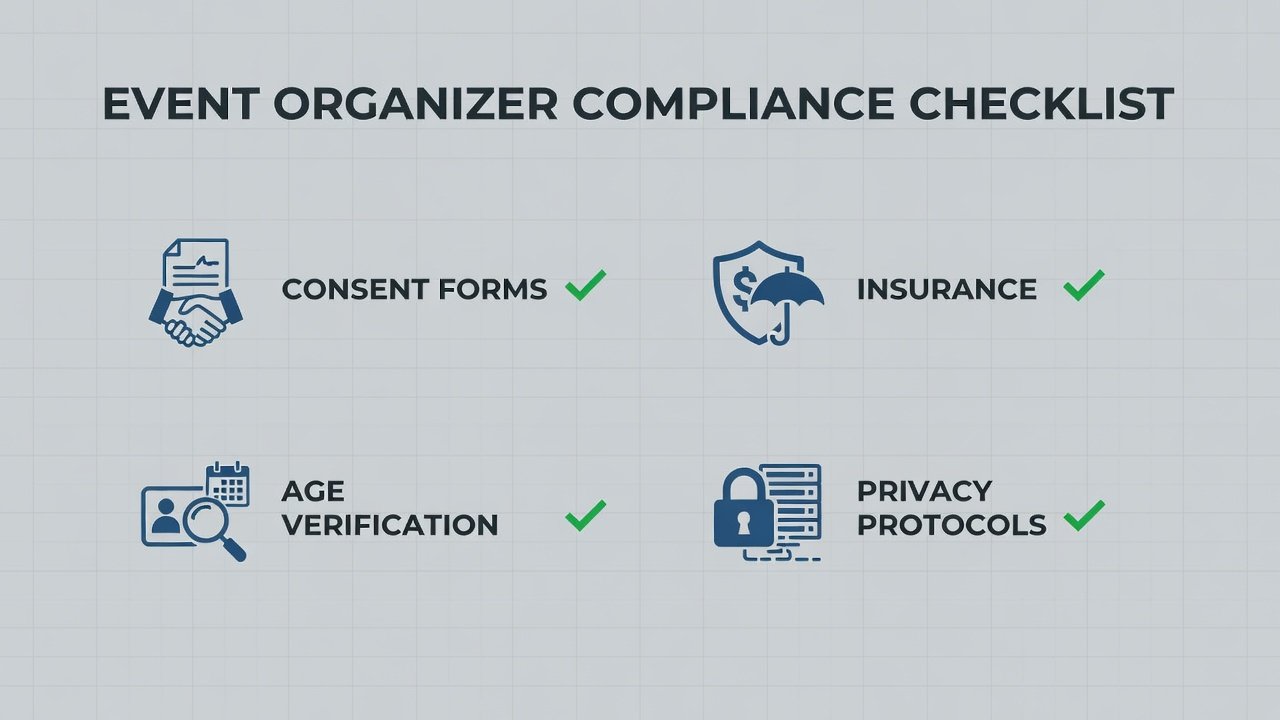
Successful event planning begins with a thorough checklist. First, confirm every participant is at least 18 years old through in-person or verified digital ID checks and retain records securely. Second, prepare comprehensive consent agreements that detail expected behaviors and revocation procedures. Third, secure appropriate venue permits and consult local authorities when the event scale warrants notification. Fourth, obtain tailored liability insurance well in advance. Fifth, develop documented procedures for receiving and resolving complaints with impartial mediators. Sixth, train all staff and volunteers on privacy protocols, emergency response, and boundary enforcement. Finally, schedule post-event reviews to update policies based on lessons learned.
Real-World Examples of Successful Risk Mitigation
One prominent organizer in a major European city implemented a two-stage verification system combining app-based ID upload with on-site confirmation, resulting in zero age-related incidents over multiple years. Another host in the United States partnered with legal counsel to draft region-specific waivers that explicitly addressed kink activities, which proved instrumental during an insurance claim review. A third example from Canada involved creating anonymous feedback channels that allowed early resolution of boundary concerns before they escalated. These cases illustrate how proactive documentation and professional consultation create resilient operational frameworks.
International Law Comparisons
Cross-border analysis reveals meaningful contrasts. The European Union prioritizes data minimization and consent documentation under frameworks overseen by the European Commission, whereas certain U.S. jurisdictions focus more on obscenity definitions and public assembly permits. The UK maintains a hybrid approach blending licensing with privacy rules. Hosts considering international events benefit from consulting local attorneys to reconcile these variances and ensure uniform standards across jurisdictions.
Practical Guidance on Age Verification and Record-Keeping
Age verification should combine multiple layers for reliability, such as government-issued photo ID presented at entry alongside digital pre-screening. Records must be stored in encrypted, access-controlled systems and retained according to the longest applicable statute of limitations in the host jurisdiction. Best practices include separating identifying information from event participation logs to enhance privacy while still satisfying legal retention demands.
Handling Complaints and Incident Response
Effective complaint management begins with published procedures that guarantee confidentiality and impartial review. Designate a trained third-party mediator to investigate allegations promptly. Maintain detailed incident logs that note timelines, involved parties, and resolutions. Transparent communication with all stakeholders, coupled with follow-up support resources, helps preserve trust and reduces the chance of external legal involvement.
FAQ: Common Questions for Hosts
How should age verification be handled?
Employ dual verification methods and maintain secure, time-limited records that comply with local data laws.
What record-keeping is mandatory?
Retain consent forms, attendance data, and incident reports in encrypted formats for the period required by the strictest applicable regulation.
How to handle complaints effectively?
Establish neutral mediation protocols, document every step, and provide access to external support services for affected individuals.
Conclusion
Navigating the legal landscape of sex-positive parties in 2026 requires diligence, professional advice, and continuous adaptation. By integrating robust consent practices, appropriate insurance, and region-specific compliance measures, hosts can create secure environments that protect participants and sustain long-term event viability. Regular policy audits and education remain essential for staying ahead of regulatory changes.

No comments yet. Be the first!