 Spicy Trip

Introduction to Group Dynamics at Modern Orgy Events
Experienced attendees at sex-positive parties understand that successful multi-partner interactions require more than enthusiasm. In 2026, orgy events emphasize refined skills in reading collective energy, interpreting subtle signals, and sustaining enthusiastic consent across fluid group configurations. This guide delivers practical protocols drawn from established play party best practices, helping participants move from passive involvement to active facilitation of harmonious group experiences. Whether you attend intimate gatherings or large-scale events, mastering these dynamics transforms chaotic encounters into deeply connective ones.
Reading Group Energy Effectively
Group energy manifests as a collective mood that shifts with arrivals, departures, and activity levels. Start by observing body language clusters: relaxed postures and open circles signal invitation, while closed formations or focused pairs suggest boundaries. Circulate slowly upon entry to absorb the room's rhythm before engaging. Pay attention to the overall tempo—some parties begin with high social mingling that gradually shifts toward sensual exploration, while others maintain a steady undercurrent of flirtation from the start.
Practical Observation Checklist
- Note vocal volume and laughter patterns as indicators of relaxation.
- Watch for synchronized movements that show alignment.
- Identify energy dips after intense scenes to time your approach.
- Observe lighting and music changes, as these often cue shifts in intensity.
- Track how newcomers integrate, noting any immediate ripple effects on existing clusters.
Successful dynamics often hinge on matching this energy rather than overriding it with personal pace. For instance, entering a subdued room with high-energy propositions can create dissonance, whereas mirroring the existing calm allows organic escalation.
Non-Verbal Cues in Dynamic Settings
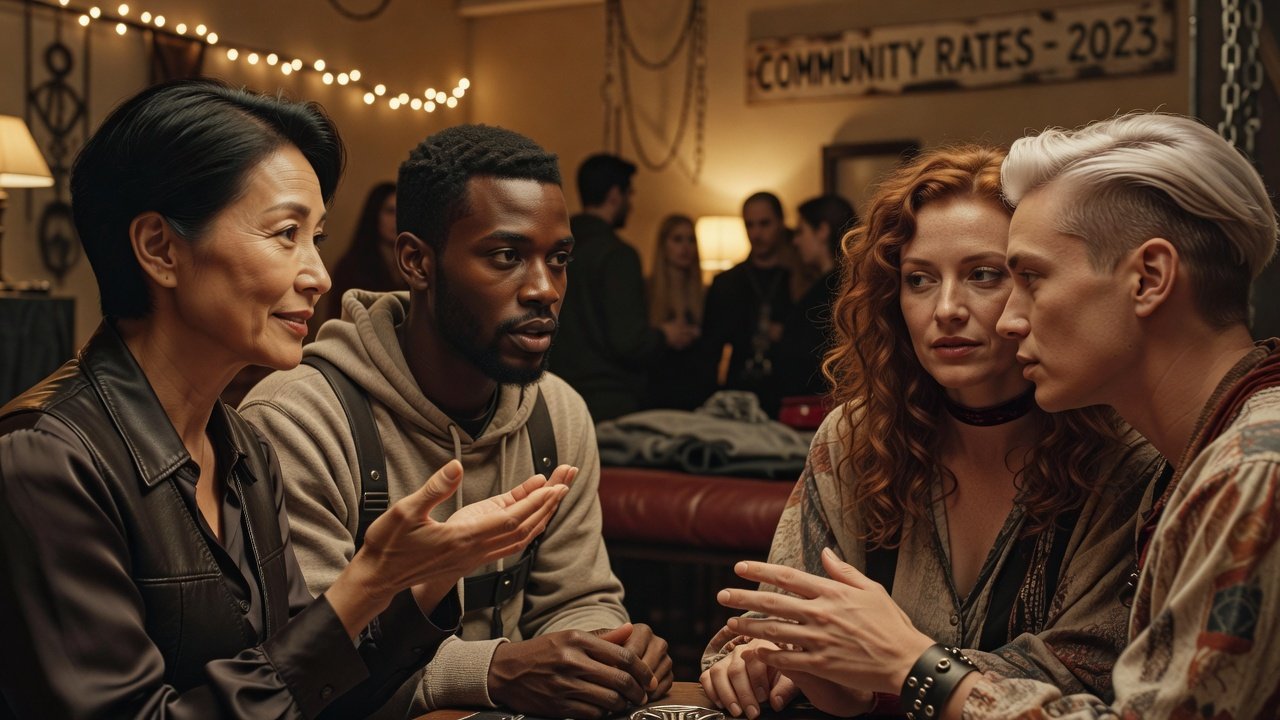
Verbal consent remains foundational, yet non-verbal signals facilitate seamless flow. Eye contact duration, hand placement, and breathing patterns convey interest or hesitation. A light touch on the arm followed by a smile typically invites continuation, while averted gaze or stiffened posture signals pause. In larger settings, these cues multiply across participants, requiring heightened awareness to avoid cross-signals that confuse group flow.
Train yourself to scan for micro-expressions every 30-60 seconds during group play. This habit prevents misreads that disrupt momentum. Advanced practitioners also use positional cues, such as angling the body toward or away from others, to guide inclusion without words. Real-world example: At a 2025 kink event, a participant used sustained eye contact and an open-palm gesture to invite a newcomer into an ongoing scene, maintaining the group's rhythm without verbal interruption.
Maintaining Consent Across Fluid Interactions
Consent in group settings operates as an ongoing negotiation. Establish a shared safe word or gesture at the outset of any multi-person scene. Reconfirm boundaries during transitions, especially when new participants join. This becomes critical in 2026 events where larger attendances increase variables. Continuous check-ins, even brief ones like a thumbs-up or nod, keep everyone aligned.
Authoritative resources such as the World Health Organization stress continuous communication in sexual health contexts. Similarly, organizations like the Kinsey Institute highlight the importance of affirmative signals in diverse encounters. Incorporating these principles reduces misunderstandings and builds trust within the community.
Step-by-Step Protocols for Scene Transitions
Transitions prevent awkward pauses and maintain flow. Follow this sequence:
- Signal intent with a brief verbal check or gesture.
- Invite the new participant explicitly while confirming existing partners' comfort.
- Adjust positions gradually to integrate without sudden disruption.
- Reassess energy levels after each addition.
- Designate a brief pause if the group size increases significantly to realign everyone.
Real-world example: At a successful 2025 event, a group of six used a rotating “check-in circle” every ten minutes, resulting in uninterrupted two-hour play. In contrast, a challenging dynamic occurred when one person joined without announcement, causing two participants to withdraw due to sudden energy shift. Another example involved a mid-scene transition where participants used a shared gesture to pause, discuss additions, and resume with renewed enthusiasm, demonstrating how structured protocols enhance satisfaction.
Small Group vs. Large Group Approaches
Small groups (three to five people) allow deeper personal connection and easier energy monitoring. They suit those refining specific dynamics or exploring nuanced power exchanges. Participants can maintain eye contact with everyone and adjust touch more intuitively.
Large groups (six or more) create immersive atmospheres but demand stronger boundary enforcement. Overstimulation risks rise, so designate a “spotter” who monitors overall consent and exits. These settings benefit from pre-agreed roles, such as one person managing verbal check-ins while others focus on physical engagement.
Comparison table in practice: Small groups excel at extended sensual touch and emotional attunement; large groups favor high-energy, varied positioning with frequent micro-checks. Choose based on your current capacity—small for focused learning, large for expansive exploration.
Actionable Etiquette Checklists
Pre-Event Preparation
- Review personal limits and hard boundaries in writing.
- Pack hydration, towels, and aftercare items.
- Arrive early to observe setup and initial arrivals.
- Research the event's specific house rules via the host's website or app.
- Practice your personal safe gestures in front of a mirror to ensure clarity.
During Play
- Offer water or breaks proactively.
- Exit scenes cleanly with thanks rather than abrupt departure.
- Respect designated quiet zones for recovery.
- Monitor your own arousal levels to prevent overstimulation.
- Facilitate inclusion by verbally naming participants during transitions.
Handling Common Pitfalls Like Overstimulation and Exclusion
Overstimulation often arises in high-intensity large groups. Counter it by stepping to the periphery, using grounding techniques like deep breathing, and signaling a temporary pause. Exclusion feelings can emerge when energy focuses on subsets; address this by offering direct invitations or creating parallel smaller interactions within the larger scene.
Comprehensive FAQ Addressing Group Dynamics Challenges
Q: How do I handle overstimulation?
A: Step back to a peripheral position, use your safe gesture, and hydrate. Rejoin only when centered. Consider designating a personal timeout signal in advance.
Q: What if someone feels excluded?
A: Acknowledge the feeling immediately, offer an invitation or alternative connection, and avoid over-apologizing which can heighten discomfort. Use inclusive language like “Would you like to join us here?”
Q: How to manage mismatched energy levels?
A: Suggest a short pause or subgroup split rather than forcing synchronization. This preserves the overall group harmony.
Q: What are best practices for aftercare in groups?
A: Coordinate group aftercare by sharing blankets, water, and quiet conversation. Check in with each person individually before dispersing.
Q: How to practice these skills outside events?
A: Role-play scenarios with trusted partners, focusing on non-verbal reading during everyday interactions to build intuition.
Conclusion
Mastering these elements elevates experiences at 2026 orgy events from chaotic to profoundly connective. Consistent practice of observation, clear signaling, and structured transitions builds confidence and community trust. Apply these frameworks responsibly to foster safer, more satisfying group dynamics that benefit everyone involved.

No comments yet. Be the first!